Six rounds, about five and a half hours of interviews, a take-home project I worked through the night on, and fourteen pages of notes I learned by heart. At the end of it: a verbal yes, a hiring freeze, no further contact. And that was that.
I am walking through the whole thing because interview processes of this length are common in this industry, and almost nobody shows what actually happens inside them. No company name. This is about the shape of the process, not about one employer.
If you have never been through one, six rounds sounds absurd. It is not, particularly. What it is, is opaque: each round has a different person with a different question they are actually asking, and if you do not know which question you are being asked, you answer the wrong one.
The second reason to show it: nobody posts the dead end. This one did not work out — the work still exists, and so does the process.
Round 1 · Recruiter
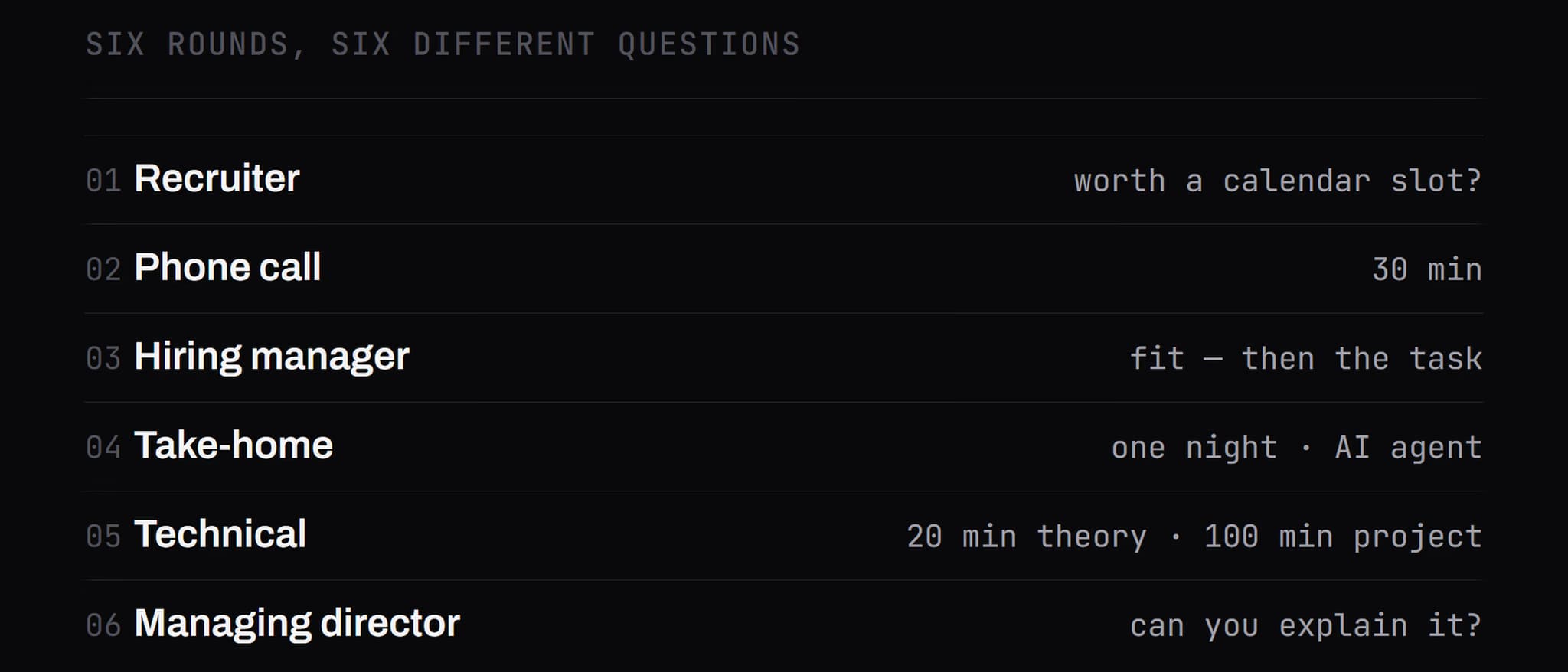
Contact over LinkedIn, external to the company, based in a different country from the engineering team. I was given detailed information about the position and asked when I would be available.
The thing worth understanding about this round: the recruiter is not evaluating whether you can do the job. They are checking whether you are worth the hiring manager's calendar. Salary expectation, notice period, whether you are actually looking, whether your profile matches the words in the requisition.
Round 2 · Phone call
Half an hour. The recruiter and I went through the position, plus a few final clarifications from my side.
Round 3 · Manager
About an hour with the person I would have reported to. More cultural than technical. This is the round where fit gets decided.
And once that was clear, the take-home task came from the same person. That sequencing is worth noticing. The task came after the fit conversation, not before it.
A company that sends a take-home before anyone has spoken to you is using candidates as a filter and not much else. Getting it at this point meant somebody had already decided I was worth several hours of their own time to review.
Round 4 · Take-home
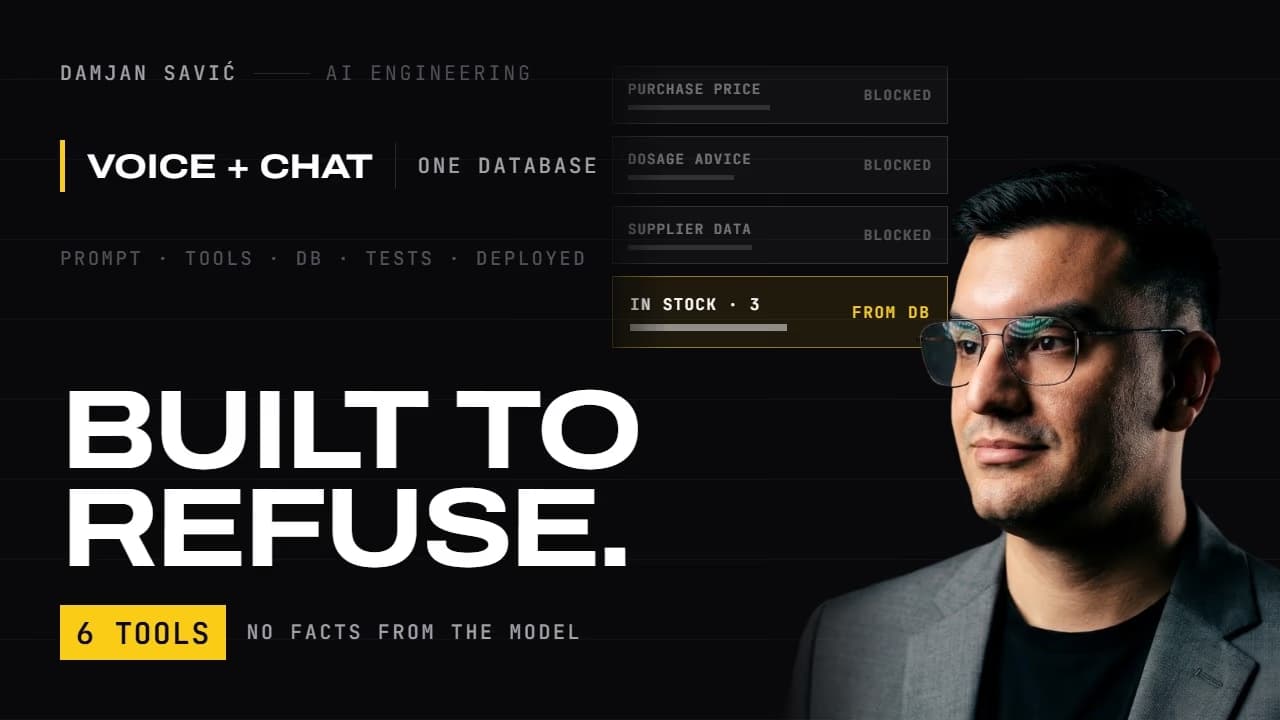
The task was to build an AI agent. I built a pharmacy assistant, voice and chat, that answers customer questions about medication.
Five days were allowed for it. I ended the interview at 4pm, started immediately, and delivered at around 2am — so I could take the next round the following day.
How it works: somebody asks a question, by voice or by text. Speech to text, then a language model with a defined set of tools, then speech back out.
Six tools:
- Medication information
- Symptom to product category
- Stock check
- Alternatives with the same active ingredient
- Interaction check
- Handoff to a human
Around them, three lists: what the agent may answer, what it refuses without exception, and — the important one — which internal data it never passes on. The agent reaches into a database that also holds supplier pricing, because it needs stock levels. It must never repeat that pricing.
The handoff
The handoff is a tool, not an error state.
If escalation is an error path, it gets tested last, guarded badly — and then it fires in your most sensitive conversation. As a first-class capability it gets a schema and it gets tests.
Then a second conversation with the same manager about the task: the whole application, front end and parts of the back end. Not especially technical.
Round 5 · Technical
Two hours with an external contact — not an employee, someone brought in to assess. Two parts, and they went very differently.
The first fifteen to twenty minutes were fundamentals. Computer science theory, networking, questions about different programming languages and how they differ. That did not go well. I had not prepared for it.
One of the questions was how the internet works — I could not explain the layers. Another was about Python, and until that moment I did not know what a GIL was.
The second part was the take-home in detail. I had fourteen pages of notes on my own project and had memorised them. That went well: architecture, tool design, why each boundary exists, what I would have built next. Two hours in total, and most of it was this.
The real mistake
I over-prepared the thing I already knew and under-prepared the thing I could not predict. That is not a small mistake, and it is an extremely common one.
Your own project is comfortable. You can rehearse it. Fundamentals are uncomfortable precisely because they are unbounded: you do not know what is coming, so preparing feels futile, so you do not, so you get caught there.
And a related thing that is true and that this industry currently is not honest about: I read code fluently, in several languages. Writing it from a blank file while somebody watches the cursor is a different skill. And the more you work with AI assistance, the further those two skills separate.
Round 6 · Director
Half an hour with the managing director for the market. This was the last step before a contract; it served to clear up open questions and to introduce the company.
This round is not a technical assessment, and it is a mistake to treat it as one. The question is whether the company wants to spend time with you — and whether you can explain what you build to somebody who will not be reading the code.
What happened after
At the end of six rounds I had a verbal yes, from the managing director included. Then a hiring freeze, and no further contact.
I do not know the reason. I could speculate, but I am not going to, because I would be guessing and presenting the guess as information.
What I will say: six rounds are a real investment on both sides, and they end in silence more often than anyone admits. Nothing in that process told me anything was wrong. Nothing was wrong. The company's situation changed, and I was not part of that decision.
If you are in a process like this: keep the other conversations warm until you have something signed. Not out of cynicism, out of arithmetic. A verbal yes is a statement of intent from people who do not control the budget.
What I would change
- Prepare fundamentals as seriously as the project. The take-home is the part you control and the part you are comfortable with. That is exactly why it is not where you lose. Five hours of interviews, twenty minutes of theory — and those twenty minutes were the only part I could not handle.
- Ask what the technical interview contains. I did not ask, and I think that was the real mistake. It is a normal question and nobody minds it: is this round mostly about my submission, or should I expect fundamentals too? That one sentence would have changed how I spent the previous week.
- Write the code by hand beforehand. Not read it — type it, from an empty file, without autocomplete, until the first twenty lines are muscle memory. Whatever your stack is, there is a small set of things you should be able to produce without thinking. Everything else can be looked up.
- The fourteen pages of notes were right, and I would write them again. They were not a script, they were a map: every decision in the project and one sentence of justification for each. When somebody asks why you chose something, you either have that sentence or you do not.
Three sentences
One: every round is a different person asking a different question. The recruiter asks whether you are worth a calendar slot. The manager asks whether you can do the work and whether they want to sit next to you. The external technical interviewer asks whether the submission was actually yours. The managing director asks whether you can explain it to a customer. Same CV, four different conversations.
Two: prepare the unbounded part. Your own project you will handle, because you built it. What gets people is the part with no syllabus.
Three: a process is not a promise until it is a contract. Run every conversation to its end. That is not disloyalty to the company you like best. It is the only version of this that survives a hiring freeze.
Takeaway
I went in assuming a process this long gets decided by the take-home. It did not. What decided it was something I had no part in.
My part was twenty minutes of fundamentals — the only stretch I could have changed beforehand. Five and a half hours of interviews, a night worked through and fourteen pages of notes hung on a verbal yes that a hiring freeze overruled.
Which is why this one is written down. Nobody posts the dead end — and the process behind it is the usual one, better read beforehand than from inside.